Thursday, May 7, 2015

Dying For The Malice In All Of Us

by Tj O'Connor Author of Dying to Know and Dying for the Past
Third time’s a charm …

Three years ago, I attended my first writer’s conference—Malice Domestic—and spent the entire three days scratching my head and trying to figure out where I belonged in this new world of cozy-mystery authors. When I came home, I said, “Nowhere.”

Of course I felt out of place. My debut novel, Dying to Know, was not yet out. I knew no one, and while I’ve never been one to stay shyly secluded somewhere, I still felt the odd-man-out. Perhaps it was that I didn’t consider myself a cozy writer. Perhaps it was that I was one of very few guys who had written a cozy (I did by accident), or perhaps it was simply that being surrounded by so many talented authors—most of which were ladies—was intimidating. I hadn’t been a rookie at anything for a couple decades and being one then scared the holy crap out of me. I’d say holy shit, but as a cozy writer, you sort of keep the colorful language to yourself … oops.

What a silly man I am.

This year, I was no longer a complete rookie. Book II, Dying for the Past, was out and I’d spent a good many weekends touring around talking about my book, signing, and begging for as many listeners as I could get. Malice this year wasn’t any different in that regard—I’m still begging for fans—but I began to feel a little at home with this crowd of amazing authors and fans. 

And damn, a few fans actually came up to me and asked, “Are you Tj O’Connor? I loved your book … would you sign …” Holy crap on a peanut butter sandwich. They loved Dying to Know and Dying for the Past. And, yes, you heard it right. I actually have a few fans! And, no, they’re not family, I didn’t pay them, and no one put them up to a joke. Fans. Real, breathing, reading fans. Who would think?
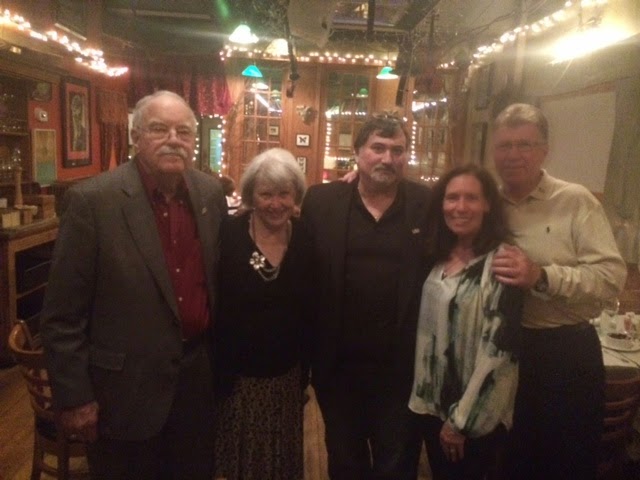
Malice was a terrific three days on the heels of an extraordinary guest speaking gig in Upstate New Jersey at the Children’s Special Hospital Charity, where I had the extraordinary pleasure of dining with my dear friends, Tom and Gale Sloan, and American Hero—Jerry Parr—the man who saved Ronald Reagan’s life—and his hugely successful and graceful wife, Carolyn, who is a retired Federal Judge (more on this one in another blog later). I sold a bunch of books, met some great people, and helped a little with the coffers of a great charity.

How on earth do you follow that one up?

Good books. Good friends. Good times.

During the weekend at Malice Domestic, I spent most of my time meeting new friends and fans (lord that sounds funny to say out loud … fans…) and swapping stories with fellow authors about how we’re muddling through this wacky business. I had the greatest time chatting and having a few drinks with my editor—the grande dame of Midnight Ink (my publisher)—Terri Bischoff, whom has single-handedly made life as a new-guy so much more bearable this past year that I don’t think she knows it.

But there were other highlights, too, that have pulled me into this family of cozy-writers.


First, there was the Midnight Ink dessert bash Friday night to celebrate 10 Years in the biz. We had amazing sweets, met some fantastic fans (there it is again … fans…), and had fun giving away a stack of books and signing for those lucky enough to get to the table first. But, being the loyal mystery readers they are, after I ran out of free books to sign, several bought them and had me sign on Saturday and Sunday. Thank you to all of you who made my day!
 
Second, there was the awards banquet for some good pals who were up for prestigious awards. It was bittersweet on a couple where friend vs. friend meant one would win and one would lose. Dinner was ehhh, but dessert —oh, la, la—(and I rarely indulge, although you wouldn’t believe that to look at me these days!) Speeches are speeches, but the event was grand. I had the distinct pleasure of sitting with my good friends—old and new—at Tracy Weber’s table. We were all rooting for her to win best first novel for Murder Strikes a Pose. Alas, it was not to be, but it’s pretty clear she’ll be heading to the podium soon.

Perhaps the best event at Malice for me was the honor of being on a panel with three brilliant and charming authors during the Sunday morning Malice schedule. Our panel was Magical Mystery Tour—Paranormal Mysteries. As Tonya Kappes—a bestselling author—said, “it was a hoot!” I was thrilled to be there among fellow authors Leigh Kelner/Perry, Tonya, and the extraordinary Charlaine Harris of True Blood fame. Our moderator was Judy Hogan, a delightful author who kept the whip cracking and the questions flying for us. While I was the low guy on the totem pole with so little experience and no notable success yet, these lovely ladies treated me like I was one of them—err, a good author, not a lady. That would have been weird, right? But, yes, what a hoot.

I was exhausted by the end of my book signing Sunday and ready to call it a weekend. How to end three days on an even higher note? Not possible. Not possible at all … but wait … maybe …

An email awaited me during the event that was the cherry on top of my third Malice. My incomparable publicist, Maryglenn McCombs, sent me this notice:

Independent Publisher Book Awards (Ippy) – Mystery/Cozy/Noir—Gold Medal—Dying to Know by Tj O’Connor.

No, you didn’t misread this. Yep, it’s real. Who would have thunk it? Not me. But Maryglenn did!

Wow. Holy crap. What a week—dinner with an American hero; meeting real fans; time with my pals and colleagues; on a panel with Tonya, Leigh, and Charlaine; and now an Ippy. What next, the Nobel? Ah, no. Just kidding.

So, book fans and wannabe authors, here’s the message. Don’t quit. Write. Write some more. Keep writing. If you have the dream, you’ll never wake up if you keep writing. I’ve been so privileged these past two years to have met some of my heroes, heard from others who shouldn’t even know my name (yes, Mr. James Grady, I’m referring to you again), and had the honor of being among some great authors and some talented, aspiring ones. You can too. Just don’t stop.

All things are possible and while I’ve had a few pretty tough weeks of late, this past one wasn’t among them. I may never become famous. I may never make the bestseller list or be able to quit my real job and write for a living (not unless my wife will agree to live in someone’s basement). And I may never make it to the level of James Grady or Stephen Frey. But I do get to hang with some of the best and most gracious people I’ve ever met.

For now, that’s pretty damn good.

Tj O’CONNOR IS THE GOLD MEDAL WINNER OF THE 2015 INDEPENDENT PUBLISHERS BOOK AWARDS FOR MYSTERIES. He is the author of Dying to Know and Dying for the Past, available in bookstores and e-books from Midnight Ink. His third paranormal mystery, DYING TO TELL, will be released January 2016. He is currently working on a traditional mystery and a new thriller. Tj is an international security consultant specializing in anti-terrorism, investigations, and threat analysis—life experiences that drive his novels. With his former life as a government agent and years as a consultant, he has lived and worked around the world in places like Greece, Turkey, Italy, Germany, the United Kingdom, and throughout the Americas—among others. He was raised in New York's Hudson Valley and lives with his wife and Lab companions in Virginia where they raised five children. Dying to Know is also a Foreword Review’s 2014 INDIEFAB Book of the Year Award finalist.

Learn about Tj’s world at:

Web Site:  www.tjoconnor.com
Facebook: www.facebook.com/tjoconnor.author
Blog: http://tjoconnorbooks.blogspot.com/
Goodreads: https://www.goodreads.com/author/show/7148441.T_J_O_Connor


Tuesday, April 7, 2015

Dying for a Little Charity

Author of Dying to Know, Dying for the Past, and the upcoming Dying to Tell
 
Since I’ve made the transition from being a writer to an author—the difference is an imaginary line between being unpublished and published (or so I’m told)—I’ve been fortunate to have experiences and meet people I never would have before. As a consultant, life revolves around problem solving. I generally meet very interesting people under the worst of circumstances—they have a problem and they need help … now. In ninety-five percent of the cases it’s a pure business arrangement, with no opportunity for friendship or camaraderie. But as an author, I’ve had the privilege of meeting the most extraordinary people without a cry for help. Most often it’s simply because we share a vocation and love of books—a small, friendly club of authors. How novel. (Sorry, couldn’t help myself.)
 
Still, I’m an unknown, and except the few who recognize an email or Facebook post here and there, no one has heard of me. In my prior government life, that was how I wanted it—anonymity meant I was below the radar. As an author, anonymity can be fatal. 

Yet despite this veil of “who are you again?” I received an invitation from an amazing charity to be one of five authors to speak at a fundraiser this month—The Children’s Specialized Hospital Friends, in Summit, New Jersey.  

Who, me? Are you sure you have the right Tj O’Connor? To my amazement, they did.

And so, on April 30th from 11 am to 3 pm, I will share the spotlight with four talented authors to help The Children’s Specialized Hospital Friends. I’ll be speaking along with Marta McDowell, author of Beatrix Potter’s Gardening Life; Jerry Parr and Carolyn Parr who wrote, Inside the Secret Service; and Jennifer Smith, author of The Statistical Probability of Love at First Sight. And all of us will be serving up “A Literary Luncheon” at the Canoe Brook Country Club in Summit, New Jersey, to help raise funds for this charity.

Here’s a little taste of what this hospital and charity are all about (from the hospital’s website):

Children’s Specialized Hospital is a non-profit rehabilitation hospital that serves over 20,000 children annually in 12 sites throughout New Jersey. The hospital serves children affected by traumatic brain and spinal cord injuries, complications from premature birth, autism, developmental delays and life changing illnesses. The hospital’s patients come from New York, Pennsylvania, Delaware, Connecticut and of course New Jersey. Renowned therapeutic programs include physical, speech, and occupational therapy; psychology services; neurodevelopmental physician services; recreational therapy and child life, and a full complement of support services.

Read more about the Children’s Specialized Hospital at http://www.childrens-specialized.org.

So, if you are in the New Jersey area, or have friends or colleagues in the area, ask them to check out this event and consider joining us. If they can’t make the luncheon, perhaps they will consider a small donation or consider passing this blog and flier along to others who might wish to support us.

FLIER DETAILS:

CHILDREN’S SPECIALIZED HOSPITAL FRIENDS

Invite you to

“A LITERARY LUNCHEON”

Thursday, April 30, 2015

11:00am to 3:00pm

Canoe Brook Country Club

Summit, New Jersey

Guest Authors

Marta McDowell Beatrix Potter’s Gardening Life

TJ O’Connor Dying to Know

Jerry Parr with Carolyn Parr Inside the Secret Service

Jennifer Smith The Statistical Probability of Love at First Sight

Ticket price for luncheon and program is $50.00

For more information or to purchase tickets please contact Marilyn Zocca

at CSHFRIENDS.EVENTS@GMAIL.COM

All proceeds to benefit Children’s Specialized Hospital’s “Friday Night Fever”

 And here’s a bonus … for the first twenty people who donate at least $50 to the Children’s Specialized Hospital charity because of this blog, I’ll send them a signed copy of Dying to Know or Dying for the Past (their choice) as a thank you from me. If they have read the books and have a favorite charity, I’ll donate the books in their name to the charity. All they have to do is email me with confirmation of the donation and reference this blog and the catch phrase, “Dying Is Overrated. Giving To Charity Is Not” and the book will be in the mail.

So come on, all my author and writer pals, pass the word along. We get a lot from writing, and I’m not talking about royalties (at least I can’t talk about royalties …) Let’s share a little of the jazz we all get from belonging to this small club of authors and book lovers.
 
End Note:  In full disclosure, this invitation did not come from any sudden fame or notoriety. Two dear friends, Tom and Gail S., who joined me for my book launch party last year, arranged my invitation. Tom is a great writer in his own right seeking publication. Gail, his wife, is a mover-and-shaker and the Fund Raising Chair for the Children’s Specialized Hospital Friends. Thanks to both of you for this opportunity and for your continued support and friendship.
 

Tj O’CONNOR IS THE AUTHOR OF DYING FOR THE PAST and DYING TO KNOW, available in books stores and e-books from Midnight Ink. His third paranormal mystery, DYING TO TELL, will be released January 2016. He is currently working on a traditional mystery and a new thriller. Tj is an international security consultant specializing in anti-terrorism, investigations, and threat analysis—life experiences that drive his novels. With his former life as a government agent and years as a consultant, he has lived and worked around the world in places like Greece, Turkey, Italy, Germany, the United Kingdom, and throughout the Americas—among others. He was raised in New York's Hudson Valley and lives with his wife and Lab companions in Virginia where they raised five children. Dying for the Past and Dying To Know are the first of eight novels to be published.  Learn more about Tj’s world at www.tjoconnor.com and on Facebook at https://www.facebook.com/TjOConnor.Author

Wednesday, March 4, 2015

Dying For A Little Class


By Tj O’Connor, author of Dying to Know & Dying for the Past & Dying to Tell

Dying is overrated. Having a little class is not.

Stop scratching your head. If you’re a struggling author like me, this will all make sense. If you’re a successful author like we all hope to be, pay attention and remember that catchphrase.
 
When I was a young boy, I had a tough upbringing at times. I read everything I could get my hands on to hide and maintain a little peace of mind. Sometimes it worked, sometimes it did not. I’ve said this many times, but my early favorites were the works Franklin W. Dixon and his Hardy Boys, Gordon Shirreffs’ The Mystery of the Haunted Mine, and Barbee Carleton’s Mystery of the Witches Bridge. They were huge stories to me and set me on the path to writing. There was a bigger influence, too, and that book came full-circle from my childhood to grab my attention this past week.

That book was Six Days of the Condor by James Grady.

Sometime in the early 70s, my older brother gave me a well-worn paperback copy of Six Days of the Condor. We didn’t have a lot in common back in those days; he was already escaping life in that small town and I was pining for my chance. James Grady’s first novel was my first “mature” novel that took me from the Hardy Boys mysteries into the world of the CIA, murder, intrigue, and thrillers. Six Days was at the beginning of a career that took Mr. Grady into journalism, politics, government, and Hollywood and continues to span decades of success. His is a story well worth catching up on.

For weeks while by brother was home visiting, we spent evenings on the front porch reliving the book and talking about politics, spies, and all that. I was, for the most part, totally lost. But, when you’re a young adventurer like I was, you keep up. This was the first time I’d connected with my brother in years, and my grandfather—who soon passed far too young for my liking—joined the discussions and spun his own tales of World War II in the pacific. That summer was one of my best memories as a kid.

To say that Six Days of the Condor affected me is an understatement.  

My young world exploded. The Hardy Boys—sorry pals—went into a box. I spent hours in the library trying to learn all I could about this new thing called the CIA and everything I could read about our government, politics, and espionage. My research—hold on youngsters, there was no internet or computers—took me days in the library to learn that the best authors were in my new love of thrillers and intrigue. I found them—Alistair MacLean, John le CarrĂ©, Mickey Spillane, Robert Ludlum, Raymond Chandler …

Holy crap! Frank and Joe Hardy never packed heat or had the hot babes! They never infiltrated Nazi strongholds or shot it out with rogue spies in Washington either. Where had I been? Grade school, of course. But, boy, was I catching up.

Six Days of the Condor opened my world to great fiction and put the icing on the cake for my future. I was going to be an author. I was going to join the CIA. I was going to fight bad guys and have real life adventure. Me. This poor, barely-passing-English-kid from an unheard-of tiny town in upstate New York. Yes, me.

We all have our heroes and reasons we are who we are. Surprisingly, so many of us get them from great books. Oh, I won’t go as far as to say that James Grady made me who I am or was the single driving force behind my past thirty-six years. No, but it’s in the top three reasons and, without question, was the turning point in my young life from that constant, nagging question, “What do you want to be when you grow up?” to a dream for chasing.

Why do I belabor this point? Because I’ve been a very lucky guy these past years and I don’t ever want to forget that. I was reminded of that this past Wednesday.

I never joined the CIA. But, for more than a decade, I was an agent with the OSI and ran investigations and anti-terrorism operations all over places most people only read about in books. I chased murderers, spies, and terrorists with some of the finest, most dedicated people I have ever known. Then, during the next few years in the private sector, I have had the fortune to have a mentor—Wally—who is one of the last surviving OSS—World War II’s Office of Strategic Services—operatives in the world and a former senior spook at the CIA. Through the years, I’ve met big shots all over—senior government (of many nations) leaders, politicians, movie stars, rock stars, et cetera, et cetera. I’ve even had the great fortune to know some amazing authors, too, many of whom have become my friends—like bestselling author, Stephen Frey, who has become a friend and influence on my books. And, all along the way, I sort of just took it in stride, never thought of what it meant or what it might come to.

Until last Wednesday.

Last Wednesday morning, I sat down to do some bill-paying work, and a note popped up on my computer from … James Grady. Holy crap on a peanut butter sandwich! Mr. Grady had—for some odd reason—found my mention of him in a blog about how I got started writing and doing my life’s work. He sat down and sent me a Facebook note to say hello. By coincidence, he is currently promoting his latest book, The End of the Condor, the next long-awaited sequel to Six Days of the Condor. In his note, he said something very important—and it is the reason for this blog—One day it would be humbling to have someone comment about me and that I should remember his words. We exchanged a couple more notes and the Ethernet returned to normal.

I heard you loud and clear, Mr. Grady. And thank you again.

I am not now, nor have I ever been, a fan boy. I’ve worked around—and even protected—celebrities and power-brokers in my life. It sort of becomes “just business.” Yet, there is something about one’s childhood heroes that breaks down the dulled senses and makes you feel like you’re thirteen years old again.

And yes, it was humbling—for me, too.

Mr. Grady took his valuable time to drop me a note and give me a little recognition. Of the tons of important and famous folks I’ve met, I can count on my fingers and toes those who ever did that. As an author, the simple fact that he thought enough about our craft and my work to acknowledge my start-up writing career was enough. But his message was ever more important.

So, what does a non-fan boy like me do when a childhood hero reaches out? Gush? Run around giggling like a school girl? (Maybe a little.) No, I grabbed my box of Midnight Ink Dying for the Past promo books (the second in my paranormal series that just released). I signed a copy with a nice note to Conan—a young aspiring writer from upstate New York—and express mailed it out. You see, Conan sent me a short story last year called The Great Pirate Adventure, which I commented on my Facebook page. He was, apparently, thrilled by that little bit of recognition. I’m not sure how old Conan is, but I hope he’s young enough to still be thrilled by a wanna-be author like me just saying hello.

Dying for the Past should be in Conan’s hands by the time this blog posts. I hope it meant as much to him as my note from James Grady. And, one day, I hope Conan writes his own novel or pursues whatever his dreams are. And, I hope he remembers my note to him and passes along that little class that Mr. Grady began this past Wednesday. 

So, as Oliver Tucker said in Dying to Know, Dying is overrated—and from me, having a little class is not.
Tj O’CONNOR IS THE AUTHOR OF DYING FOR THE PAST and DYING TO KNOW, available in books stores and e-books from Midnight Ink. His third paranormal mystery, DYING TO TELL, will be released January 2016. He is currently working on a traditional mystery and a new thriller. Tj is an international security consultant specializing in anti-terrorism, investigations, and threat analysis—life experiences that drive his novels. With his former life as a government agent and years as a consultant, he has lived and worked around the world in places like Greece, Turkey, Italy, Germany, the United Kingdom, and throughout the Americas—among others. He was raised in New York's Hudson Valley and lives with his wife and Lab companions in Virginia where they raised five children. Dying for the Past and Dying To Know are the first of eight novels to be published.  Learn more about Tj’s world at www.tjoconnor.com and on Facebook at https://www.facebook.com/TjOConnor.Author


Saturday, February 7, 2015

Dying is Toughest When It's Your Best Friend

By Tj O’Connor, author of Dying to Know, Dying for the Past, and Dying to Tell

 
As a mystery writer, death becomes almost clichĂ©—at least, fictional death. It’s the heart of a story and everything surrounds it. We treat death as no more than a plot and the make-believe root of our writing lives. It’s easy to forget what death really is.

In real life, it’s truly a killer.

Saying good-bye is one of the hardest thing I’ve done in my life. It was no matter that it came at the end of a long, wonderful, and full life, either. It was still hard. Gut-wrenching. Sad.

I am generally a tough guy—not a muscled bouncer or martial arts Ninja—although in my past years I could be pretty tough, too. No, I control my emotions from others’ perception and choose to most often. Friends and family have thought me removed, even unfeeling at times. That’s not from a lack of emotion—no, not all—but from an ability to take those feelings and lock them up when it’s needed. Maybe it’s from years under an abusive father. Maybe it’s from my often tumultuous past life. Or, perhaps, it’s just my way of protecting myself.

But not with Mosby. Not when it was his time. I lost my way to the emotion-lockbox. My stone exterior crumbled to tears and pain—a weeping, trembling wreck. My boy—best friend and companion—was done. Mos, my 90 pound yellow Lab had reached the end of his 14-plus years and couldn’t go on. He had tumors, cancer, arthritis, and lord only knows what else—although you’d never know it. We cared well for him and up until the last week of his life, there had been little pain but for the arthritis in his knees. A few good meds and my carrying him up and down stairs whenever he wished took care of that. He repaid me with devotion. When not stalking me for a treat or meal, he was sleeping close to my desk or at my feet watching a movie. Never complaining. Never grumbly or irritable. Never far away. 

At the end, he was just done—his life was yesterday and there was no more to have. His body was failing and his dignity was nearly spent. His pure bred Lab companions—Maggie, the Chocolate, and Toby, the Black—were constant attendants. Toby walked at his side up and down the stairs whenever I was not near—gently pushing him against the wall to keep him from stumbling. Mags found me whenever the old boy needed something and I failed to noticed. He had raised them from pups and they were shouldering him in his last days.

People should have such compassion and loyalty. People should try to understand the love and devotion that Mos gave to everyone. I challenge you.


As a young dog, Mos grew up with five teenagers my wife and I raised in North Western Virginia. His favorite things were food, toys, family, food … and rules. If there was a rule in the house—for dog of child—he enforced it. If the boys were getting too rough around the basement pool table, Mos summoned me. If my cooking threatened to alert the smoke alarm, he barked a warning. If one of the other dogs were out of line, he sought their correction.

Except at Christmas time. Rules be damned.
 
Christmas with five teenagers was a free-for-all. And our kids always made sure they had a wrapped present for Mos and the others. And up until Christmas morning, they hid presents in their rooms out of sight and mind. Did you ever try to hide a dog toy from a Lab? Before Christmas Eve, Mos would have found each and every one of his presents and deftly opened them—so much for rules! One year, he opened my daughters closet door to dig beneath the family presents and retrieve his own. How? Because at an early age he learned to roll his nose between doorknobs and doorframe and open a door. How did he know which were his gifts and which were not? Practice.

His favorite game—other than eating—was hide and seek. One of my daughters, and later one of my grandchildren, often played with him often. She’d sneak away and hide, and within minutes, Mos had patrolled the house and sniffed her out. A bark, a pat, a treat, and he was on the chase again.  

Mos was the center of the family and for good reason. He played Frisbee with everyone. Stayed close for the beer pong and pool games. Was within arm’s reach of the grandchildren as they learned to walk and play. He even sat at the dinner table—yes, in a chair—to listen to evening banter and share in the laughs. But no responsibility was as important to him as being my co-author, office mate, late-night movie partner, and constant foot-warmer. Well, perhaps dinner-time taste-tester! Even at the end in my home office, Mos barked for me to help him move from wherever he was to wherever I was—that distance could be no more than feet. If that was in the basement gym, than damn the stairs and carry him down.

Mosby died Veteran’s Day—three months ago. It’s only been a short time and I still get up in the morning and step careful beside the bed for fear I might step on him. As I work in my den, his ashes are nearby beside a ceramic likeness and a photograph. It’s taken me these three months to have the clearness of vision to write these words. Yet, I cannot say good-bye. The starch of my emotions fail me with his memory so much that I cannot bury him—should we ever leave this home, I could never leave him behind.

What a sap. What a woosie boy. What a cry-baby! No—he earned every tear I’ve shed.

My only solace is that at 14 +, he did not go because of his ailments over the years that I lined up doctors to cure. He loved life and family and dinner and toys. He reveled in the love he received from all of us. His life had been so full, it could simply take no more. There was nothing more for him and he made room for another to find this home. In time—not soon—we’ll do that.

Life is like that. It gives and takes. I think you have to give first because when it takes, it’s too late to make up for the loss. You have to pay in advance. With Mos, we paid plus interest. I know he knew that. At the end, he found the strength to climb onto my bed—something he hadn’t done in over two years—and lay his head on my lap. He wanted me to know it was time ... and that it was okay.

Mosby’s his first love, Belle, passed this last week, too. Belle was Mos’ age and was my daughter’s dog. We got her thirteen years ago to be his companion while the family was at work. They grew up together and when my daughter married and moved across the county, Belle went with her. We, of course, had brought Maggie into the family by then. Like Mos, Belle succumbed to life. She was14 plus years, too, and had a full life. Losing those two so close together was devastating to us all. Strangely, one has to wonder if they were not supposed to be together. Dogs need companionship—perhaps here and there, too.

One can hope.

My current mystery series, The Gumshoe Ghost, has Hercule, a black Lab as a key character. Not because I wanted to fit into the cozy community or knew in advance having an animal was chic. I included Hercule because Labs are so much a part of my life that I couldn’t see my character not having one. In the future, the importance of a dog will have a new meaning.

I’m still surrounded by sweet, loving Labs (and another daughter’s Mastiff, too). They keep me company as I toil over my keyboard. They are a great comfort and as close to me as Mos ever was. Yet, no matter how close they are, there is still that void.

I hope it doesn’t leave too soon. Pain is a reminder of loss. I don’t mind keeping him around a little while longer—even if it’s painful. Nothing so important should be easily lost.

A lot of you will understand me having to commit this to words. For those of you who can’t—or who call me a silly man—you have no idea what you’re missing. Deep down, loss reveals something so amazing.


 Tj O’CONNOR IS THE AUTHOR OF DYING FOR THE PAST and DYING TO KNOW, available in books stores and e-books from Midnight Ink. His third paranormal mystery, DYING TO TELL, will be released January 2016. Tj is an international security consultant specializing in anti-terrorism, investigations, and threat analysis—life experiences that drive his novels. With his former life as a government agent and years as a consultant, he has lived and worked around the world in places like Greece, Turkey, Italy, Germany, the United Kingdom, and throughout the Americas—among others. He was raised in New York's Hudson Valley and lives with his wife and Lab companions in Virginia where they raised five children. Dying for the Past and Dying To Know are the first of eight novels to be published.  Learn more about Tj’s world at www.tjoconnor.com and on Facebook at https://www.facebook.com/TjOConnor.Author


Saturday, January 10, 2015

Dying for the Past - Roots of the Sequel - Part II

By Tj O’Connor, author of Dying to Know, Dying for the Past, and Dying to Tell 

It’s here. Hold the presses. Ready the fireworks. Make ready the launch … Dying for the Past hits the shelves tomorrow! Detective Oliver Tuck” Tucker is back in Book II of his Gumshoe Ghost series, and he’s ready to solve another case. This one, as explained in Part I of this two-part blog “Dying for the Past—The Roots of this Sequel” centers around the murder of a wealthy and mysterious philanthropist with connections to a 1930s mobster’s journal containing the secrets of Washington D.C.’s powerbrokers, gangsters, and spies.    

Everyone wants the book. And they’ll do anything—especially kill—to get it.

In Part I of this blog, I explained that Tuck is up against Vincent Calaprese, the spirit of a 1930’s gangster, the Russian Mob, and several conniving suspects. Someone killed Stephanos Grecco—a wealthy philanthropist—in front of a hundred charity gala guests dancing the night away. The story surrounds the search for Vincent’s journal—the book—in which he kept tabs on spy rings, mob bosses, and corrupt Washington D.C. elite. Vincent used his journal to persuade the FBI from shutting down his operations and keep his mob competition at arm’s length. Over the years, the book became a shield against the growing Russian mob and corrupt government officials. To mess with Vincent’s family meant risking the book telling its stories.

This subplot is based on true events.  

During the run-up to WWII, some mob leaders helped our government thwart, and in some cases, directly combat our enemies. Known mob kingpins are believed to have kept track of Axis spies operating in the country and reporting activities to the authorities, in particular, with ports and rail yards where sabotage was a threat. During those years (and perhaps still today), the mob had special access to ports, rail, and coastal cities —they had their own networks controlling the docks and cargo throughout the country; they also had enormous power over the labor unions working those areas. I suppose that while they were mobsters and racketeers, they were still Americans and, in a world war where nationalism was the battle cry, even the bad guys waved the flag.

One story has it that Meyer Lansky, along with a key mob boss and pal, Salvatore C. Luciano, a.k.a. Lucky Luciano, played key roles in keeping union dockworkers from striking during the war and aiding in the successful invasion of Sicily by American forces. Further, Lansky helped our government recruit fellow mobsters, Bugsey Siegel and Lepke Buchalter. The three gangsters were reportedly merciless at intimidating potential German-American Nazi sympathizers to keep them from gaining any foothold in the country. These men also played other roles while working for the government. Lucky Luciano also reportedly played a vital role in aiding the U.S. invasion of Sicily. Luciano was a notorious Italian boss with power in both the U.S. and in Sicily. According to historical accounts, Luciano traded his freedom from prison for his assistance in helping secure intelligence and cooperation from Sicilian mob assets.

There’s a long list of other mob aficionados who aided our government in fighting the Axis powers here and abroad. Few of them our government owned up to after the war. One story even suggests Luciano parachuted into Sicily behind enemy lines to make contact with mobsters—a significant power in Sicily—and organize them to aid the Allied invasion.

With history like this, how could I resist? So, while creating Vincent Calaprese and his delectable girlfriend, Sassy, I penned Vincent as a hot-cold, good-mobster, bad-mobster kinda guy. His connection to pre-WWII espionage and corruption is the backstory of Dying for the Past—and what better vehicle to connect the past with the present than a dangerous journal that named names and could blaze a trail to modern day espionage and corruption in 2015? And of course, the book and its stories were worth killing for.

The next ingredient in my story is Tuck’s family background and what secrets his unknown past might reveal. For those of you who have read Dying to Know, you know that Tuck was an orphan raised in foster care. He never knew anyone or anything about his family. In Dying to Know, we learn that Doc, his cantankerous spirit guide, is family. In Dying for the Past, we’ll begin to learn that being a ghost is hereditary and Tuck’s roots may well include mobsters, spies, cops and robbers, and a host of wayward spirits—pun intended. Ultimately, as Tuck’s stories continue, all the books will be connected through Tuck’s family past. There is a method to my madness and an intricate web of spirited lineage that will tie the cases—and the characters—all together. It suffices to say that Tuck’s murder was not an accident—and neither was Doc’s or the rest of Tuck’s family. In fact, they were all dying to get together. Wow, is that another book title?

Why am I so connected to the past myself? I have no choice—my own family tree has some interesting stories, too.

As a young boy, my grandfather, Oscar, told a few tales of his life in the 30s and 40s. As a very young man, he took to life as a hobo and rode the rails around the east coast looking for adventure—and work—during the Great Depression. In WWII, he was one of the oldest draftees and his exploits included working for a Military Intelligence Officer in the Pacific Theatre. My great uncle, John, was a drummer for the likes of the Dorsey Brothers, Gene Kruppa, and Glenn Miller. While I don’t think anyone ever heard of him, my grandparents were his biggest fans and instilled a love of Big Band and Swing music in me. In Dying for the Past, that music plays a unique role in Vincent Calaprese’s chapters and help me keep his era alive throughout the story. And last, but perhaps most significant is my mentor for the past 24 years, Wally, who is one of the last remaining OSS operatives (Office of Strategic Service—the forerunner to the CIA) still alive today. After the war, Wally joined the CIA and became one of its senior executives through the cold war and into the 80s. He fought the Germans in Northern Africa and Europe, fought the communists in Greece, the Russians throughout the world, and all enemies in between (and I dare say a bunch of Washington bureaucrats, too) until his retirement. His exploits and his life story are a constant source of material for my books. It is no secret that Wally is thinly disguised as Doc—Tuck’s omnipotent, brassy spirit mentor—in all of Tuck’s stories.

As you can see, history is a big part of my life and is a constant theme throughout my books. In my upcoming Dying to Tell, Book III in Tuck’s series, the OSS and a WWII operation in the Middle East play a significant role in a series of murders. Dying to Tell releases in January 2016.

For you history and mystery aficionados, I hope you’ll give Dying for the Past and Dying to Know a read. When you do, drop me a line at tj@tjoconnor.com and let me know what you think.

For the New Year, stay safe and well!


TJ O’CONNOR IS THE AUTHOR OF DYING FOR THE PAST and DYING TO KNOW, available in books stores and e-books from Midnight Ink. His third paranormal mystery, DYING TO TELL, will be released January 2016. Tj is an international security consultant specializing in anti-terrorism, investigations, and threat analysis—life experiences that drive his novels. With his former life as a government agent and years as a consultant, he has lived and worked around the world in places like Greece, Turkey, Italy, Germany, the United Kingdom, and throughout the Americas—among others. He was raised in New York's Hudson Valley and lives with his wife and lab companions in Virginia where they raised five children. Dying for the Past and Dying To Know are the first of eight novels to be published.  Learn more about Tj’s world at www.tjoconnor.com and on Facebook at https://www.facebook.com/TjOConnor.Author


Monday, December 8, 2014

Dying for the Past - The Roots of this Sequel- Part I

By Tj O’Connor, author of Dying to Know & Dying for the Past

Countdown—39 days to the launch of Dying for the Past, my first sequel to Oliver “Tuck” Tucker’s debut in Dying to Know. Tuck is back in Book 2 and he’s on a new case with the help of his beautiful and brilliant professor-wife, Angel, and Detective Bear Braddock, his always faithful, always-protective ex-partner. Or maybe I’m describing Hercule, his black Lab companion. Both I think.

Tuck has just started settling down into his new life as a dead detective after wrapping up his own murder and ending the killing spree of a serial killer. Things have been going well for him—all things being considered that is.  

Tuck finds that being dead is often bittersweet. He explains a little in Chapter 1 of Dying for the Past
 
Sometimes, being dead is not so bad. Like poofing in and out of places on a whim without bothering with doors and stairs. And you never have to pee or get the flu again—big pluses. Then there are times, though, when dead is depressing and sad. It’s the things you miss—the taste of good wine, the adrenaline-rush of chasing a suspect, or the feeling when you’re in the middle of the dance floor with the most beautiful woman in the room. Those moments hurt.

A woman with shoulder-length auburn hair and sparkling green eyes stood in the middle of the mansion’s ballroom. Her long, silky gown was icing poured hot over sultry curves. All eyes fixed on her when she embraced a tall, distinguished-looking older man before a dance. He wore a tux—okay, yeah, he was striking with gray hair and a strong, muscular build, brilliant, rich, blah, blah, blah. Big deal. The two could have been on a wedding cake, but instead were the center of attention at Angel’s big band-themed charity gala, and leading a turn around the floor to Glenn Miller’s Moonlight Serenade.

 When they took their first step, I turned away …

Then wham. Someone’s dead. Not just any someone, mind you, but a shifty rich guy with a carnation on his lapel and a beautiful, but angry young bride on his arm. The only things anyone knows about this mysterious philanthropist is that he has too much money, too beautiful a young wife, and one-too-many bullet holes in him.

Mr. Carnation hailed a passing waiter for a refill of champagne. After downing the glass in a single gulp, he lifted Angel’s hand for a melodramatic kiss.

His glass shattered and spasms jerked his body all the way to the floor. His right arm thrust out and pointed at the crowd; his left still held the broken glass stem. His body twitched a few more times and stilled …

… I’d seen death before—and murder, too often. Not just my own, but dozens.

This one was unmistakable. It wasn’t the way Mr. Carnation collapsed in a jerky, melodramatic spiral to the hardwood. It also wasn’t the way his dull, lifeless face caught the dance ball light either. It was much simpler.

It was the blood pooling around his body and the bullet hole through his torso.

Someone murdered Mr. Carnation—shot him in front of two hundred witnesses. A killer jitterbugged in and gunned him down to Benny Goodman.”

In Dying for the Past, Tuck realizes pretty quickly that it’s all about just that—the past. For Tuck, his past started to haunt him (pardon the pun) after his murder. You see, being dead also comes with some perks—spirited perks, like touching crime scene objects that show him a few snippets of their meaning (though often veiled) and being able to move about without the delays of traffic or bad weather. He can pop in and out of places at a whim. He just has to know where he wants to be. No, he has no after-life intuition or clairvoyance—it always comes down to plain old detective work. Now, he has to figure out how to use his new-found talents and a couple unusual characters to solve the case.

“Across the room, standing alongside the dance floor, was an uninvited guest. He was a stout, striking man in a black pinstripe, double-breasted suit. He wore shiny, buffed wingtips and a gray felt fedora. The only thing missing was a big cigar hanging out of his mouth and a violin case. Then, he swept his hand across his jacket and revealed a heavy semi-automatic in a shoulder holster. Did someone invite Al Capone?

He looked at me and winked. Winked …

 … Voices hushed as eyes fell on the dead man.

Not me, though, I watched the crowd, looking for the killer and any telltale sign of the smoking gun.

But what I saw, or didn’t see, unnerved me more.

The gangster in the black pinstripes was gone … vanished—poof. He arrived just in time for a killing and left before the body hit the floor. No sign of his spats and black tie remained. He didn’t leave his fedora or heater behind either. He was as dead and gone as Mr. Carnation.

The question was, however, would he stay that way?”

In Dying for the Past, Tuck begins to learn some of his own family secrets. First, after witnessing the murder of Stephanous Grecco in front of his wife and a hundred people at the Vincent House—no one saw anything—Tuck finds himself searching for the killer and wondering what it all has to do with his own family tree. What does he find along the way?

·       Vincent Calaprese—the spirit of a 1939 mobster boss with his hooks into Tuck’s family tree.

·       Sassy—the eye-candy delight always on Vincent’s arm and always after Tuck’s eye.

·       Doc Gilley’s secret just within arm’s reach. Can Tuck get the truth out of him?

·       Someone stalking Angel, but what does it have to do with Steve and Bonnie Grecco—the new rich elite in Winchester? And what does AndrĂ© Cartier, Angel’s only family and mentor, have to do with all of it?

·       Why are the FBI, US Attorney’s Office, and a television ghost-hunter all converging on the Vincent House?

·       Also, why is Poor Nic Bartalotta—retired New York mob boss extraordinaire—connected to the Russian Mob and missing federal snitches?

·       Aove all, who will find The Book—Old Vincent’s gangster journal holding the secrets to a bundle in loot and the names and evidence on the who’s who of Washington D.C.’s World War II spies, mobsters, and corrupt-elite. You’d be surprised how many are still around these days.

The answers come from the past and the victims are Dying for the Past.

Stay tuned to this channel—same The Plot Thickens time, same Plot Thickens Channel. Next month, I’ll disclose some of the past behind Dying for the Past. Like …

·       What’s the backstory to Vincent Calaprese and his pre-World War II escapades?

·       What’s the story behind Tuck, Doc, and his wayward ancestors?

·       Why am I so connected to the past myself? What skeletons and secrets do I have hidden deep away?

If you can guess any of these answers, drop me a line here or email me at tj@tjoconnor.com

Be looking for Dying for the Past out on your bookshelves January 8, 2015!

Tj O’Connor lives in Virginia with his wife and three Labs. Dying to Know is the fourth of his eight novels and is currently available in bookstores and online. Dying for the Past, the first of two sequels, will be released in January 2015—available now for pre-orders. Tj is an international security consultant specializing in anti-terrorism and investigations. Learn about his world at www.tjoconnor.com and Facebook at www.facebook.com/TjOConnor.Author.


Wednesday, October 29, 2014